As the bucket elevator height increases...
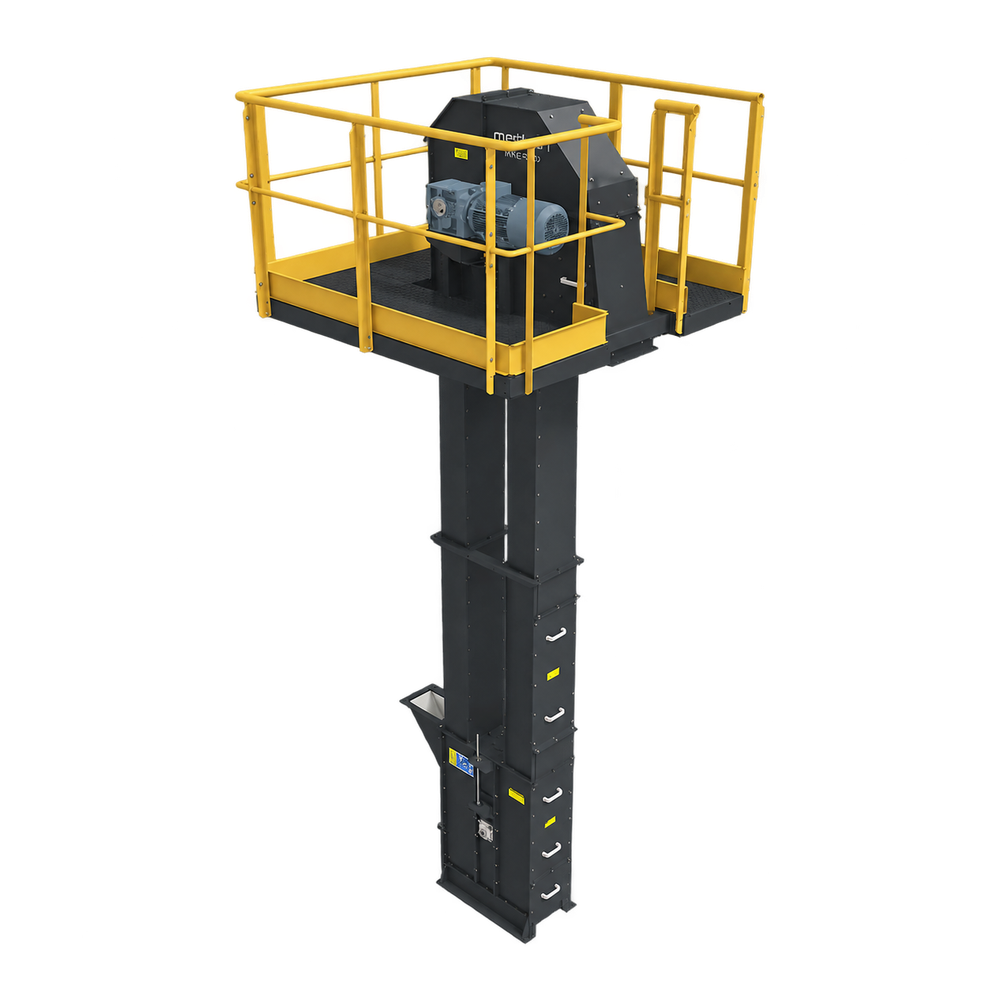
Bucket elevators are used to convey powdered and granular materials vertically.They facilitate the orderly transfer of products between floors, particularly in processing plants. However, as the conveying height increases, so does the mechanical load on the system. Therefore... Bucket elevator selection One should not proceed based solely on capacity values. A short elevator and a tall elevator do not create the same operating conditions. As the height increases, the belt or chain carries a greater load. The drive system encounters a heavier load. Casing stability becomes more critical. Furthermore, maintenance and safety requirements change.
For instance, a facility might wish to extend an existing 10-meter-high elevator to 25 meters. However, simply adding new modules to the casing is not the correct solution. The increased height imposes new loads on the motor, gearbox, pulley, and belt or chain. At Metkan, bucket elevator we evaluate the conveying height in the context of the entire system during our projects. We analyze the target capacity, product characteristics, and operating conditions. We then configure the drive system and the conveying structure based on this data. In this section, we will examine in detail how height bucket elevator we will examine in detail how it changes the design.
Contents
- Why is bucket elevator height important?
- What changes in the system when the height increases?
- Does the choice between belt and chain systems depend on height?
- What is the relationship between capacity and height?
- How does motor power change with height?
- Why does the selection of the gearbox become critical?
- How does the load on the belt or chain change?
- Does the choice of bucket depend on height?
- Why does casing design become critical?
- Why is material fallback important in tall systems?
- How is the lifting load evaluated?
- How does the maintenance plan change based on height?
- Can the height of an existing elevator be increased later?
- How is the right bucket elevator selected?
- Frequently Asked Questions
Why is bucket elevator height important?
Bucket elevator heightrefers to the vertical distance between the product's inlet point and its discharge point. As this distance increases, the system transports the product to a higher point. Consequently, the drive system consumes more energy. However, height affects more than just motor power; the amount of product being conveyed within the elevator simultaneously increases. For instance, a 30-meter system operating at the same capacity involves a longer conveying line than a 10-meter system. Therefore, the belt or chain bears a higher total load.
Additionally, the system's own weight increases. A longer belt, more buckets, and a taller casing alter the mechanical design, thereby increasing the forces acting on the conveying components. For this reason, operating height should not be considered in isolation; the design team must evaluate height in conjunction with capacity, product density, and the drive system.
What changes in a bucket elevator when the height increases?
An increase in height directly affects many parts of the system. First, the total length of the conveying element increases. Belt systems require a longer belt, while chain systems require a greater total chain length. Additionally, the number of buckets increases. Each additional bucket adds its own weight to the system, and the product inside the buckets further increases the total load during operation. Consequently, the mechanical load that the drive system must handle rises.
The motor and gearbox must generate torque suitable for these new operating conditions. Furthermore, the drive pulley or chain sprocket must be capable of handling the new load. The casing design also changes; taller structures require more rigorous structural analysis. Connection points, service platforms, and maintenance access become increasingly important. Therefore, an increase in height implies more than just adding a few meters of casing; the entire system requires evaluation based on the new operating conditions.
Does the Choice Between Belt and Chain Systems Depend on Height?
Belt or chain Bucket elevator selection does not depend solely on height. Material temperature, density, abrasiveness, and target capacity also influence the choice. Belt systems offer efficient operation for many dust and granular applications. Lower moving mass provides a significant advantage in certain processes, and they also offer quieter operation for suitable products.
Chain-based systems offer distinct advantages under demanding operating conditions. A chain-based design may be particularly preferable for a project when product temperature and mechanical loads are high. However, the weight of the chain itself adds to the total system load. For tall elevators, the design team must carefully calculate the tensile load on the conveying element. Therefore, a blanket rule stating that "tall systems must use chains" is not necessarily correct.
At Metkan, we decide between belt and chain systems based on process conditions, treating height as a crucial factor in this evaluation.
What is the Relationship Between Capacity and Height?
Bucket elevator capacity is primarily determined by bucket volume, bucket spacing, and conveying speed.The bulk density of the material also directly affects the throughput (t/h). Height alone does not determine the theoretical conveying capacity; however, as height increases, the system must perform more mechanical work to maintain the same capacity, because the elevator is lifting the same quantity of product to a higher elevation.
Consider, for example, two elevators transporting 30 tons of product per hour. The first system lifts the product 8 meters, while the second lifts the same product to a height of 30 meters. Although both systems handle the same tonnage, the second system performs more lifting work. This difference directly impacts motor power and mechanical design; consequently, the equipment configuration changes even if the capacity calculation remains the same.
How Does Motor Power Change with Height?
The motor provides the mechanical energy required to convey material vertically. As the conveying height increases, the same quantity of product must be lifted to a higher point; consequently, the power demand on the motor rises. Simply put, three main factors determine the power requirement: the quantity of material conveyed, the conveying height, and mechanical losses within the system. Therefore, when high capacity and a long conveying distance are combined in a single project, the drive system becomes increasingly critical.
However, relying solely on theoretical lifting power when selecting a motor does not yield accurate results. Operational startup loads must also be taken into account. Furthermore, mechanical friction and gearbox losses must be factored into the calculations. At Metkan, we evaluate motor power based on the system's actual operating conditions, thereby avoiding the use of motors that are either undersized or unnecessarily oversized.
Why Does Gearbox Selection Become More Critical?
While the motor generates the necessary power, the gearbox produces the appropriate output speed and torque. Therefore, gearbox selection for tall bucket elevators directly impacts drive performance. As height increases, the system carries a greater total load. The gearbox encounters high torque, particularly during a "loaded start" scenario. Consequently, the service factor and operating characteristics require careful evaluation.
Incorrect gearbox selection leads to more than just a loss of performance; it can also result in excessive heat, mechanical wear, and unexpected downtime. Additionally, the output speed directly affects the elevator's operating speed. An incorrect ratio causes the buckets to move at an unsuitable speed. This impairs filling and discharging performance.
Therefore, the motor and the gear unit should not be selected independently of each other. Both components must operate within a unified drive system.
How Does the Load on the Belt or Chain Change?
As the height increases, the self-weight of the belt or chain rises. At the same time, the system carries more buckets. During operation, the product inside these buckets is also added to the total load. Consequently, the tensile force on the conveying element increases. This load reaches significant levels, particularly in high-capacity systems. For belt elevators, the design team must verify belt strength and connection points. Drum diameter and belt tension are also critical factors.
In chain-based systems, chain strength, connections, and sprocket design are key considerations. The self-weight of the chain imposes a significant mechanical load in tall systems. Therefore, the design team must not limit calculations to the product inside the buckets; they must also account for the total weight of the conveying system and the buckets themselves.
Does Bucket Selection Vary Based on Height?
Product characteristics are the primary criterion for bucket selection. The material's particle size, density, and flow characteristics influence bucket geometry. However, as height increases, the total number of buckets rises, making bucket weight increasingly important. An unnecessarily heavy bucket system imposes a constant additional load. When dealing with dozens or hundreds of buckets, even small weight differences add up to a significant total.
Bucket volume must also align with capacity requirements. Buckets that are too small require closer spacing or higher speeds to achieve the target capacity. Conversely, buckets that are too large transfer higher instantaneous loads to the drive system. Therefore, bucket geometry and the conveying system must be evaluated together. Proper bucket selection maintains capacity while keeping the total mechanical load under control.
Why Does Casing Design Become Critical as Height Increases?
Bucket elevator casing encloses the mechanical system and supports structural integrity. As height increases, so does the number of casing sections. This heightens the importance of connection points. Precise alignment plays a critical role in tall structures; deviations along the casing axis can disrupt the operation of the belt or chain. Consequently, the conveying element may drift toward the casing, leading to increased friction.
Facility layout also influences casing design. Service platforms, inspection points, and maintenance access must be planned during the project phase. At Metkan, we do not focus solely on the internal mechanism of tall bucket elevators; we also incorporate the casing structure and facility connections into the system design.
Why Is Back-Spillage Important in Tall Systems?
Back-spillage refers to the phenomenon where the product discharged from the bucket falls back into the elevator before reaching the discharge point. This situation causes capacity in a bucket elevator bucket elevator. However, the impact of energy loss becomes more pronounced in tall systems. The system conveys the product upwards over a distance of many meters. If a portion of the product falls back after the discharge point, the elevator ...conveys the same material back up. Consequently, the motor consumes unnecessary energy.
Furthermore, the back-spilled product re-enters the system at the lower section. This can disrupt the bucket filling pattern. The increased load also places strain on the drive system. Correct bucket speed and discharge geometry reduce back-spillage. Additionally, an appropriate discharge arrangement plays a critical role. Therefore, the design of the discharge point is of particular importance in tall systems.
How is Start-up Load Evaluated in Tall Elevators?
Normal operation and the start-up phase do not present the same load conditions. In particular, when an elevator fully loaded with product restarts after stopping, the drive system encounters a high initial load. In tall systems, the quantity of product being conveyed simultaneously is greater. Moreover, the long belt or chain imposes an additional load on the drive system. Therefore, start-up torque is a key criterion in the selection of the motor and gearbox. constitutes an important selection criterion.
Controlled start-up systems reduce mechanical shocks. However, no control system can replace an accurate drive calculation. The motor and gearbox ...must first be capable of handling the actual load. Additionally, unplanned operational stoppage scenarios must be considered during the design phase. The system must be able to restart safely following a power outage or process stoppage.
Why Does the Tensioning System Become More Important as Height Increases?
Belt or chain must maintain the correct operating tension. Insufficient tension causes slippage and irregular movement, while excessive tension places unnecessary strain on bearings and drive components. As the height increases, the total length of the conveying element increases; consequently, elongation and changes in operating conditions become increasingly significant.
In belt-based systems, temperature and load fluctuations can affect tension. In chain-based systems, mechanical elongation occurs over the course of operation. Therefore, the tensioning system must offer a sufficient adjustment range. A proper tensioning mechanism supports the stable movement of the conveying element. It also ensures a more controlled transfer of the force generated by the drive system.
Why Is Alignment Important in Tall Bucket Elevators?
Alignment issues cause wear even in short systems. However, as height increases, minor axial deviations lead to more serious consequences. If the belt or chain drifts from the centerline, it may come into contact with the casing. This contact increases friction and causes wear along the edges of the conveying element.
Precision during casing installation is therefore crucial. Pulley or sprocket alignment must also maintain the same axial configuration. The maintenance team should monitor for abnormal noises and vibrations during operation. Additionally, belt tracking systems can provide early warnings, allowing the operator to perform necessary checks before a major mechanical problem arises.
How Does the Maintenance Plan Change Based on Height?
Elevator As the elevator height increases, maintenance access requires more extensive planning. Intermediate inspection points become just as important as the bottom and top drive sections. The maintenance team must regularly inspect the conveying element and monitor the belt or chain for wear. Bucket connections should also be included in the inspection checklist.
In the upper drive assembly, the motor, gearbox. and bearing checks are crucial. In the lower section, the tensioning system and product accumulation must be monitored. For tall systems, it is not appropriate to consider maintenance access only after the project is completed; platforms and service areas should be incorporated into the layout during the design phase. This allows the facility to manage scheduled maintenance time more effectively.
Can the Height of an Existing Bucket Elevator Be Increased Later?
Facilities may wish to extend an existing elevator to a greater height during plant revisions. However, simply adding new modules to the casing is not the correct approach. First, the existing motor and gearbox must be capable of handling the new load. Next, the strength of the belt or chain must be verified. The drive pulley, tensioning system, and connections must also be compatible with the new operating conditions.
Additionally, the structural stability of the casing requires re-evaluation. The new discharge height alters the plant layout and the product discharge geometry. Therefore, at Metkan, we re-evaluate the entire system for elevator height extension projects. This allows us to determine—based on technical data—which parts of the existing equipment can be retained and which components need to be replaced.
How Do You Select the Right Bucket Elevator Based on Height?
The correct selection begins with defining the process data. The facility must clarify its target capacity (t/h). Next, the material's bulk density and particle structure must be assessed. The conveying height is factored into the system alongside this data. Finally, the bucket volume and bucket spacing are determined. Operating conditions are analyzed for both belt and chain-based configurations.
The design team calculates the motor and gearbox requirements and verifies the total load on the conveying element. Calculations regarding the casing structure, tensioning system, and discharge geometry complement this process. Ultimately, evaluating height in isolation does not ensure the selection of the correct system. Bucket elevator selectionis based on the balance between capacity, product characteristics, and conveying height.
How does Metkan evaluate height in bucket elevator projects?
Metkan We approach every bucket elevator project based on process data. First, we examine the properties of the product to be conveyed. Next, we determine the target capacity and the required conveying height. In the subsequent stage, we evaluate the bucket geometry and the conveying system. We select the motor and gearbox configuration based on the actual operating load. Additionally, we plan the casing, tensioning, and discharge sections as part of the integrated system.
For tall systems, we prioritize maintenance access alongside mechanical load considerations. Sustainable production is not defined solely by capacity; the facility must also be able to perform safe and routine maintenance on the equipment. Our goal goes beyond simply lifting the product to the desired height; we aim to create a balanced and sustainable vertical conveying system that aligns with the production line's capacity.
Frequently Asked Questions
Does the motor power increase as the bucket elevator height increases?
Yes. When the system transports the same amount of product to a higher point, it performs more mechanical work. Additionally, longer belts or chains and an increased number of buckets raise the total load. Therefore, the design team calculates the motor power based on the new conveying height.
Are belts or chains preferred for tall bucket elevators?
It is not correct to make this decision based solely on height. Factors such as product density, temperature, abrasiveness, and target capacity influence the choice. Metkan selects either a belt or chain system based on specific process conditions.
Does the elevator height reduce capacity?
Height does not directly alter the theoretical volumetric capacity. However, a taller system requires greater power and mechanical strength. If the drive system does not meet these requirements, actual operational performance will decrease.
Can the bucket elevator height be increased later?
The system height can be increased following a technical analysis. However, simply adding casing sections is not sufficient. The motor, gearbox, belt or chain, tensioning system, and casing structure must be checked against the new operating conditions.
Why is product back-spillage a more critical issue in tall bucket elevators?
Spilled product is conveyed upwards again. Consequently, the system consumes energy a second time for the same material. This energy loss becomes more pronounced over greater conveying heights.
How is the conveying height determined for a bucket elevator?
The plant layout and the process point the product must reach determine the conveying height. This establishes the operational inlet and discharge elevations. The system design is then shaped according to this vertical distance.
Why is the tensioning system important in tall bucket elevators?
Long belts or chains exhibit greater variations in length during operation. The tensioning system maintains the correct operating tension, ensuring the conveying element moves more stably.
How is maintenance planned for tall bucket elevators?
The maintenance plan must cover intermediate inspection points in addition to the top and bottom sections. Operations personnel should regularly inspect the belt or chain, bucket connections, tensioning system, and drive assembly. Service platforms facilitate access for the maintenance team.
Size Your Bucket Elevator System Correctly with Metkan
Conveying height in bucket elevators As it increases, it is not just the casing length that changes. The motor-gearbox system, belt or chain load, number of buckets, tensioning structure, and casing design must also be adapted to the new operating conditions.
At Metkan, we evaluate your material properties, target capacity, and conveying height collectively. For a new bucket elevator investment or for capacity and height revisions to your existing system: Metkan with contact us.